Boron in nuclear energy
Nuclear energy requires ultimate precision and control. Without it, a nuclear power plant’s safety may be compromised.
With its unique chemical composition, boron possesses special aptitude for absorbing radiation. That’s why boron is used in light water reactors—enhancing the shielding, control, and safety of the most critical stage in nuclear energy operation.
Because nuclear energy is a highly specialized industry, materials such as boron must conform to exceptionally rigorous purity, granulometry, and quality standards from a reputable supplier.
For years, many nuclear power stations have trusted U.S. Borax to meet the stringent expectations and demands of this sensitive sourcing challenge. As a global leader in refined borate products with proven nuclear energy experience, we can help you with high-quality products that balance your need to harness energy while maintaining unparalleled safety and control.


How does boron help control nuclear reactions?
Thanks to its atomic structure, boron is effective at absorbing neutrons during the crucial nuclear fission stage. Boron can control the rate of the reaction, slowing or stopping the reaction, if needed.
The 10B isotope, present at around 20% natural abundance, has a very high nuclear cross section and can capture the thermal neutrons that result from the fission reaction of uranium nuclear fuel.
Nuclear energy accounts for more than half (56%) of the carbon-free electricity generated in the US.
Inside boron’s role in nuclear energy: Boiling water reactor vs. pressurized water reactor
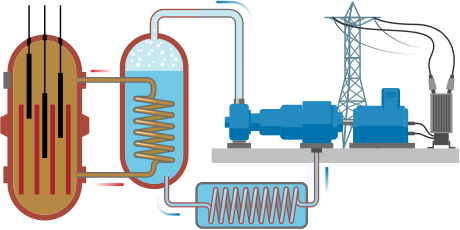
Whether you’re using a boiling water reactor (BWR) or pressurized water reactor (PWR), borates play a key role in ensuring the safety and control of the emergency core-cooling systems.
In both systems, nuclear technicians can inject borates into the nuclear reactor core should an emergency occur. Out-of-control reactions can be quenched with boric acid, which will absorb neutrons rapidly.
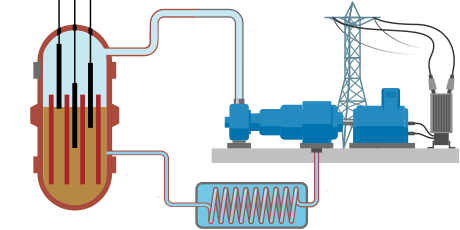
Pressurized water reactor
Dissolving boric acid (Optibor®) in your PWR’s primary cooling circuit allows you to adjust the quantity of 10B in the reaction environment and remove heat from the reactor core. Adjusting 10B controls the rate of a nuclear reaction and subsequently, the energy the reaction generates.
Boiling water reactor
Unlike PWRs, BWR cooling circuits don’t utilize borates. In BWRs, boron is used in:
Control rods (made of boron carbide)
Fuel storage pools
Standby liquid control system tank
Additional uses
Shielding: Steel and plastics used in various applications throughout a nuclear power plant add boron to absorb neutron radiation.
Corrosion inhibitor: In the secondary unit of PWRs, nuclear energy producers may use sodium borates in the secondary circuit to inhibit corrosion.
Nuclear control rods: Found in the nuclear reactor’s core, boron carbide rods act as a primary neutron absorber. Boron carbide rods are used in both PWR and BWR systems.
Emergency application: Nuclear power plants typically store large volumes of boron on-site to safeguard against emergencies. If an issue is found and a shutdown is necessary, technicians can use boron to quench an out-of-control reaction.
Why choose U.S. Borax as a boron supplier for nuclear energy?
Decades of quality management experience and high production standards make us the right partner for the nuclear energy industry.
Precision matters
We know your power plant runs nonstop, and you must have complete control over the reaction environment. Using high-quality, consistent borates is essential. Every batch of U.S. Borax product must meet tight particle size distribution thresholds and purity standards.
Nuclear expertise
Our extensive nuclear energy experience equips us with the knowledge to help you meet extremely stringent regulatory and quality standards. You’ll have access to robust safety and quality documentation, ensuring your borates align with requirements set by standards such as 10 CFR 50 Appendix B of the U.S. Nuclear Regulatory Commission.